
The U.S. economy grew faster than previously estimated in the second quarter, with consumer spending and business investment helping offset weaker areas of growth.
U.S. growth was stronger than the government first estimated
The U.S. economy expanded at a 2.2% annual rate from April through June, according to the latest Commerce Department estimate. The figure is an upgrade from the earlier 1.5% estimate.
The revised number gives a clearer picture of how the economy performed during the second quarter of 2026. Growth slowed from the 2.5% pace recorded in the first quarter, but it remained supported by consumers and businesses.
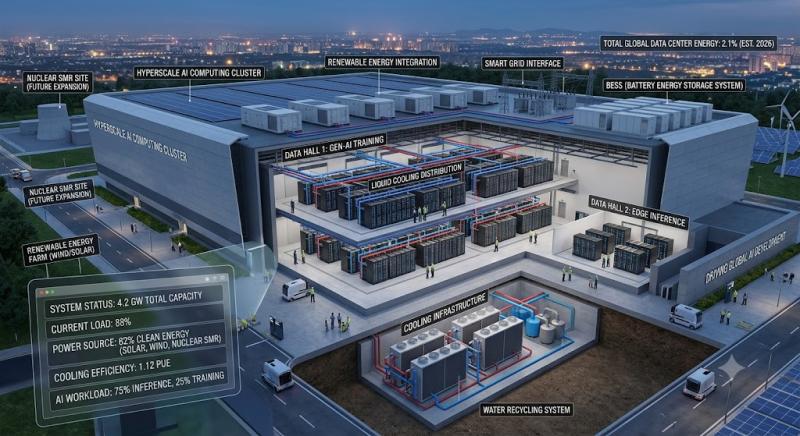
The latest report also highlights a growing connection between economic growth and investment in artificial intelligence. Companies have continued spending heavily on computing equipment, data-center infrastructure and other technology needed to expand AI systems. Reuters and the Associated Press both identified AI-related investment as an important part of the latest growth picture.
Consumer spending provided a major boost
Consumer spending, which represents roughly 70% of U.S. economic activity, increased at a 3.8% annual rate in the second quarter. That was a substantial improvement from the 0.7% pace recorded during the first quarter.
The stronger consumer contribution helped keep overall growth positive even as some other parts of the economy remained under pressure.
AI investment is becoming harder to ignore
One of the most notable parts of the report was business investment. Investment outside the housing sector increased at a 9% annual rate, reflecting continued spending on equipment and technology.
AI infrastructure has become an important part of that investment cycle. Companies are spending on advanced computer chips, servers and data-center capacity as demand for AI computing continues to expand.
The Commerce Department data also showed a sharp increase in imports during the quarter. Imports rose at a 12.6% annual rate, partly reflecting increased shipments of computer chips and other products connected to AI investment.
The latest numbers suggest that AI is no longer just a technology-sector story. Investment linked to AI is becoming part of the broader U.S. economic growth picture.
Why imports reduced the headline growth number
Imports are subtracted when calculating GDP because the measure is intended to capture domestic production. That means a large increase in imports can reduce the headline growth figure even when businesses are purchasing more equipment and products for future investment.
During the second quarter, the increase in imports reduced reported GDP growth by nearly 1.7 percentage points, according to the Associated Press.
That makes the headline 2.2% figure only part of the story. Several underlying measures of economic activity were stronger than the headline number suggests.
The economy's underlying momentum
A measure that removes some of the more volatile components of GDP showed considerably stronger growth. The underlying measure increased at a 4.6% annual rate in the second quarter, compared with 1.8% in the first quarter.
Another measure combining GDP and gross domestic income showed growth of approximately 2.4% during the quarter.
- Consumer spending
- Business investment
- AI infrastructure
- Underlying domestic demand
- Higher energy costs
- Housing affordability
- Higher borrowing costs
- Large import growth
Why strong GDP does not tell the whole household story
A stronger economy does not necessarily mean that every household experiences the same improvement. Housing costs, energy prices, borrowing costs and differences in income can affect how economic growth is felt by consumers.
The latest GDP report therefore provides evidence of continued economic activity, but it does not by itself measure household financial conditions or consumer confidence.
What happens next
Attention now turns toward the third quarter. The first government estimate for third-quarter GDP is scheduled for October 29.
Investors and economists will also continue watching consumer spending, business investment, inflation and the performance of the labor market. Those indicators will help determine whether the strong second-quarter performance is continuing into the second half of the year.
The latest data show a U.S. economy that remained resilient in the second quarter. Consumer spending and business investment provided important support, while the rapid expansion of AI infrastructure has become a visible part of the investment story. The next major question is whether that momentum can continue as households and businesses face higher costs in other areas.
Frequently asked questions
How fast did the U.S. economy grow in Q2 2026?
The latest estimate puts annualized second-quarter GDP growth at 2.2%.
What helped drive U.S. economic growth?
Consumer spending and business investment were major contributors, with AI-related investment playing an increasingly important role.
How much did consumer spending increase?
Consumer spending increased at a 3.8% annual rate during the second quarter.
When will the first Q3 GDP estimate be released?
The first government estimate for third-quarter GDP is scheduled for October 29.
Reporting and economic figures are based on the latest U.S. Commerce Department data as reported by Reuters and the Associated Press.
Post a Comment
Have something to add? Share your thoughts or let us know what you think about this story.