
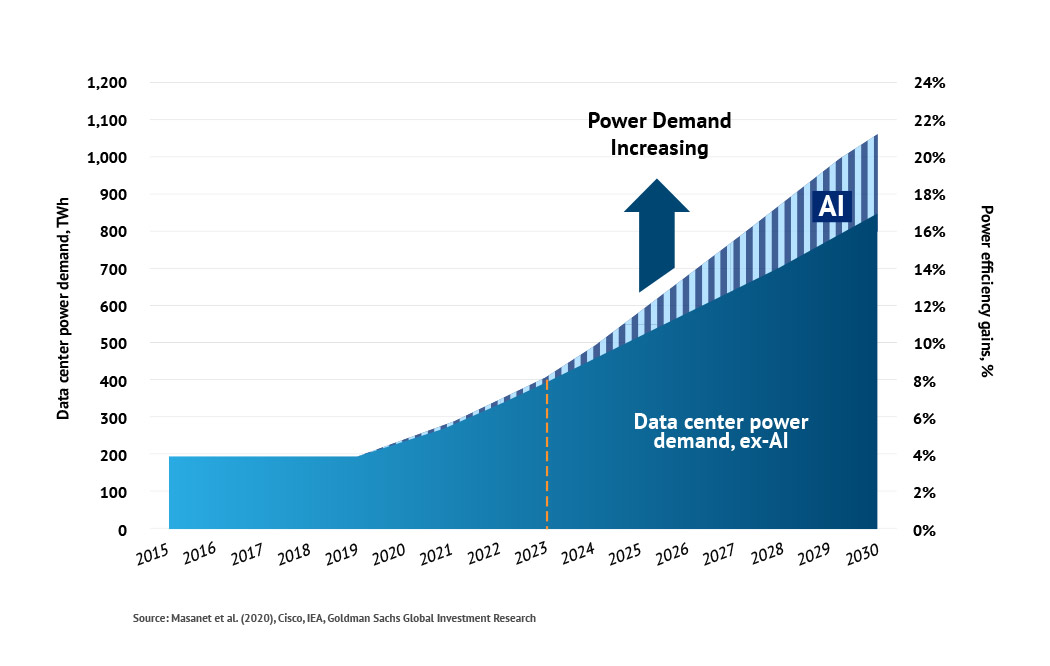
America's artificial intelligence boom is creating a problem that has little to do with computer chips: there may not be enough electricity infrastructure ready to power all of the data centers being planned.
Technology companies are committing enormous amounts of money to AI infrastructure, but building servers is only one part of the equation. Those servers need reliable electricity, and the U.S. power grid cannot expand at the same speed everywhere.
New analysis from TrendForce says the gap between the electricity demand implied by AI-server shipments and the capacity that the U.S. grid can actually deliver is expected to widen, with the problem becoming more significant toward the end of the decade.
AI companies can build more computing capacity, but those facilities cannot operate at full scale unless enough power reaches them.
AI is turning data centers into power projects
Traditional data centers already consume substantial amounts of electricity. AI has changed the scale of the requirement because high-performance computing systems use far more power and are being deployed in much larger numbers.
TrendForce estimates that global data-center power demand capacity will reach 161 gigawatts in 2026, with AI servers accounting for about one-third of that demand. The research firm expects AI's share to continue rising in the years ahead.
That means the AI infrastructure race is increasingly becoming an electricity and transmission race as well.
The grid cannot expand overnight
Adding data centers is generally faster than building the transmission lines, substations and generation capacity needed to serve them.
A large facility can require hundreds of megawatts of electricity, while some planned campuses are designed around power requirements measured in gigawatts.
The Washington Post has documented how massive data centers are spreading across the United States, including in areas where large projects are transforming farmland and other previously undeveloped land.
Newspriint has already covered the wider U.S. AI investment and data-center boom . The power issue adds another layer to that expansion.
Where the pressure is building
The challenge is not simply the total amount of electricity available in the country. Location matters.
A data center may be proposed in an area where the existing transmission network cannot provide enough capacity. Moving power from another region is not always straightforward because transmission infrastructure also needs to be expanded.
TrendForce identifies several major U.S. grid regions where delays could affect data-center development, including PJM, ERCOT and MISO.
This can create a situation in which a company has land, financing and computing equipment ready to go but still has to wait for the necessary power infrastructure.
Why this matters for AI companies
The AI industry is spending heavily on infrastructure because companies want enough computing capacity to train and operate increasingly capable models.
But higher infrastructure costs and longer construction timelines can change the economics of those plans.
Companies may have to secure electricity years before a data center is fully operational, negotiate directly with utilities, build dedicated generation or adjust where new facilities are located.
That makes access to electricity an increasingly important part of the competition between AI companies.
Communities are also watching the buildout
The power question is not limited to technology companies and utilities. Local communities are also paying closer attention to how data centers affect electricity systems, water resources, land and infrastructure.
A JLL report released earlier this year found that North American data center demand reached a record level in the first half of 2026. The report also highlighted the importance of community engagement around electricity, water and noise as the industry expands.
Newspriint recently reported on Anthropic's massive AI infrastructure commitments , which provide another example of how much computing capacity leading AI companies are trying to secure.
More data centers could mean more energy projects
The growing electricity requirement is already influencing how companies think about data-center locations and energy supply.
Some projects are being developed close to existing power resources, while others are considering dedicated generation and long-term energy agreements.
The result is that AI infrastructure is increasingly connected to the broader U.S. energy system. The construction of a data center can now influence decisions involving electricity generation, transmission and local infrastructure.
The numbers are still moving quickly
TrendForce projects that global data-center power demand capacity will continue growing rapidly through the end of the decade. At the same time, AI servers are expected to represent a progressively larger share of that demand.
The U.S. therefore faces a timing problem: AI companies want computing capacity now, while major electricity infrastructure projects can take years to plan, approve and construct.
If the two timelines do not move closer together, some planned data-center projects could face delays even when demand for AI computing remains high.
What to watch next
The next phase of the AI infrastructure race will not be measured only by how many chips companies purchase or how many data centers they announce. Access to reliable electricity will become an increasingly important part of the picture.
Utilities, technology companies and local governments will have to coordinate on new generation, transmission capacity and the infrastructure needed to connect large computing facilities to the grid.
For the AI industry, the question is becoming straightforward: how quickly can computing capacity expand if the power needed to run it cannot expand at the same pace?
Post a Comment
Have something to add? Share your thoughts or let us know what you think about this story.