
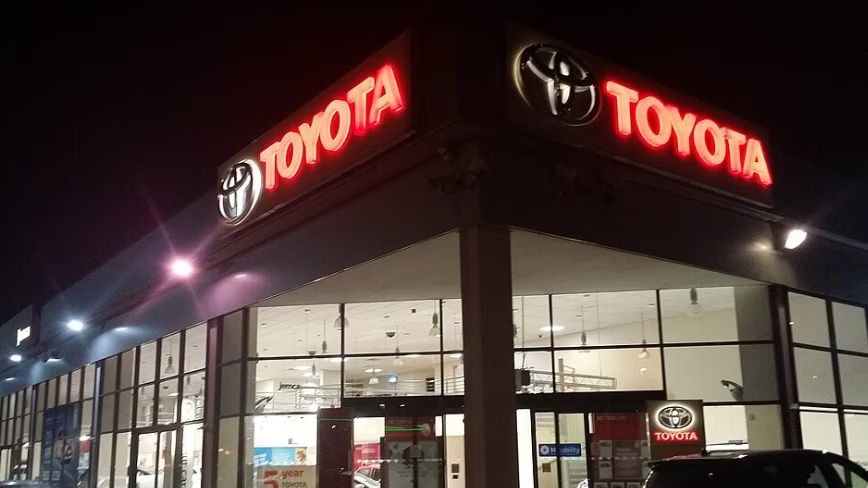
The U.S. auto market is showing a noticeable shift as higher gasoline prices push more buyers toward fuel-efficient vehicles. General Motors remained the country's biggest automaker by quarterly sales, but Toyota moved closer to the top spot during the third quarter of 2026.
General Motors sold 670,974 vehicles in the United States during the quarter, down 5.5% from a year earlier. Toyota Motor North America sold 633,223 vehicles, up 0.6%, leaving fewer than 38,000 vehicles between the two companies.
GM: 670,974 U.S. vehicles in Q3
Toyota: 633,223 U.S. vehicles in Q3
Toyota's gap to GM: 37,751 vehicles
Why Toyota is gaining ground
One of the clearest differences between the two companies is their approach to hybrid vehicles.
Toyota has spent years expanding its hybrid lineup, giving shoppers alternatives to both traditional gasoline vehicles and fully electric cars. That strategy is becoming more relevant as gasoline prices remain elevated.
Reuters reported that Toyota's Corolla hybrid sales increased nearly 36% from a year earlier to 13,003 vehicles during the third quarter.
Toyota's overall U.S. sales were nearly flat, but the strength of its hybrid lineup helped the company maintain demand while some parts of the electric-vehicle market weakened.
GM's sales declined during the quarter
GM's third-quarter U.S. sales fell from 710,347 vehicles a year earlier to 670,974.
The company has also seen a sharp decline in electric-vehicle sales. Reuters reported that GM's EV sales fell 62% from the same period last year, when buyers were still rushing to purchase vehicles before the federal EV tax credit expired.
That change has made the mix of vehicles sold by each automaker increasingly important.
Gas prices are changing buying decisions
Fuel costs have become a bigger consideration for American car shoppers. Reuters reported that the national average price for regular gasoline reached $4.43 a gallon in September, compared with $3.20 a year earlier.
Higher fuel costs can make vehicles with better fuel economy more attractive, particularly for drivers who travel long distances or use their vehicles every day.
That environment has helped hybrid models receive more attention while consumers remain cautious about the higher purchase prices associated with many new vehicles.
Ford is seeing the same hybrid trend
Toyota is not the only automaker reporting stronger interest in hybrids.
Ford said its third-quarter U.S. sales fell 6.6% to 509,764 vehicles, but executives told Reuters that demand for hybrid powertrains was increasing.
Ford's hybrid-equipped Maverick pickup was particularly strong, with sales rising more than 20% to 41,970 vehicles during the quarter.
That suggests the shift toward hybrids is not limited to small passenger cars. Automakers are seeing interest across different vehicle categories.
EVs are facing a different market
The latest sales figures also show that the U.S. vehicle market is not moving in a single direction.
Fully electric vehicles face a different set of challenges following the expiration of the federal EV tax credit in 2025. Some automakers have reduced EV production plans while continuing to invest in hybrids and other powertrain options.
Tesla, however, reported stronger-than-expected third-quarter deliveries. The company delivered 486,532 vehicles globally during the quarter, exceeding the 456,896 vehicles expected by analysts.
Newspriint recently covered Tesla's stronger-than-expected Q3 deliveries .
The affordability problem remains
Fuel economy is only one part of the decision facing American car buyers. The price of the vehicle itself remains a major factor.
Reuters cited Cox Automotive data showing that the average new-vehicle transaction price reached $50,089 in August, up 1.9% from a year earlier.
Even when borrowing costs decline, higher vehicle prices and lower trade-in values can keep monthly payments elevated.
This creates a difficult balance for consumers: finding a vehicle that fits their budget while also limiting the long-term cost of fuel and ownership.
GM's lead is still substantial
Toyota's progress does not mean the U.S. sales ranking has already changed. GM still sold substantially more vehicles than Toyota during the third quarter.
But the size of the gap has become much smaller, and the latest sales figures show how quickly consumer preferences can affect the competitive landscape.
The fourth quarter will provide another indication of whether Toyota's hybrid-heavy lineup can continue gaining ground while U.S. shoppers deal with high fuel prices and elevated vehicle costs.
Post a Comment
Have something to add? Share your thoughts or let us know what you think about this story.